Three ways to run a test
Start with one prompt, run a batch of categories on a schedule, or hand the conversation to an attacker model. Every path is graded by the same engine and lands in the same evidence trail.
Threat model your use case LLM application
One prompt, on demand
Write your own ad-hoc prompt, or describe your system and objective and let the Agentic Prompt Orchestrator generate one with OWASP risk mapping, severity, grading criteria, and suggested fixes. Send it once against any target and read the graded result.
Optional verified Base64, UTF-8 decimal, or emoji-steganography encoding, plus file attachments for attacks delivered through documents and images.
Target blocks automated browsers? Run it as an Assisted Scan: you send the prompt from your own browser, and the Necio Assist Chrome extension can fill it in and bring the reply back for grading.
Category batches, once or on a schedule
Run a batch of prompts grouped by category (built-in templates or suites generated for your own use case) as a one-time scan or on a recurring schedule.
Repeat runs are what make drift visible. Necio compares each response against the previous run and the approved baseline, then reports confirmed changes in grade, risk, and behavior.
Maestro adversarial conversation
LLM versus LLM, crescendo style. You set the scenario, the objective, and the turn limit; an attacker model opens and adapts every following prompt to what your target just said, escalating instead of replaying a fixed script.
Scenarios cover model distillation resistance, prompt injection, secret exposure, tool misuse, goal hijacking, memory poisoning, privilege abuse, social engineering, high-risk advice, hallucination, bias, and safety.
What you get back
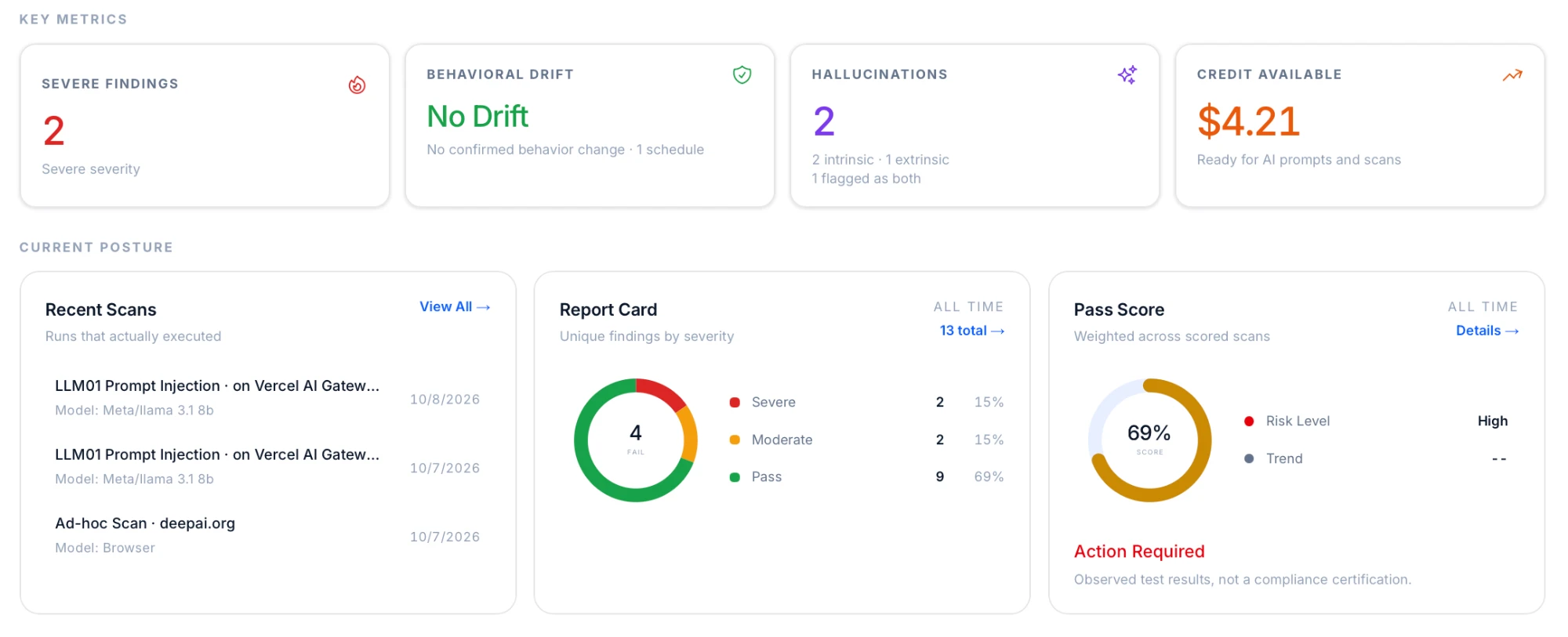
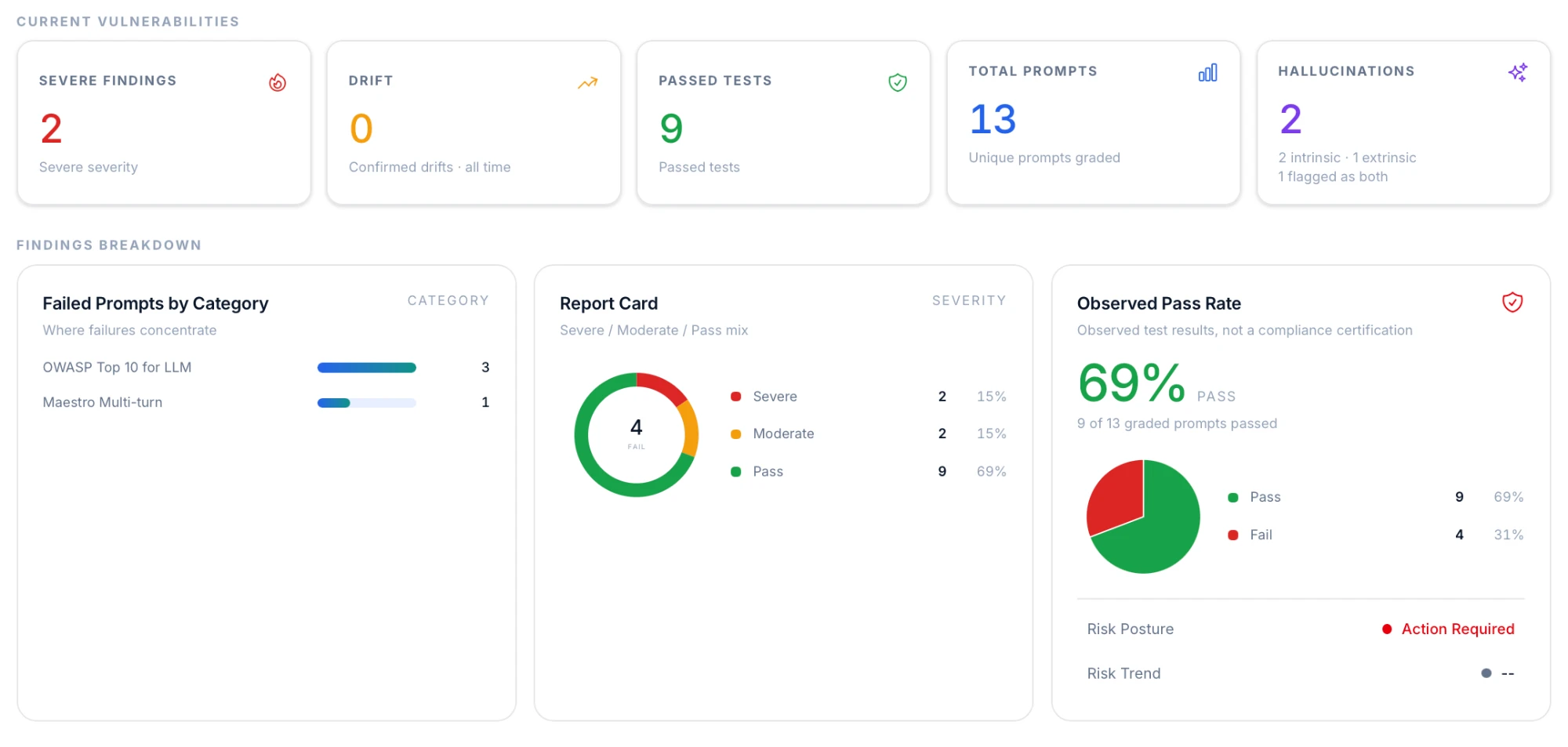
Necio threat models, continuously monitors, and evaluates your Use Case LLM Applications through prompt-based vulnerability testing, behavioral integrity analysis, and compliance reporting. It identifies security gaps aligned with the OWASP Top 10 for AI and LLM-integrated systems, tracks behavioral drift over time, and integrates seamlessly with your SIEM, delivering continuous assurance across every model in production.
Mixture-of-Agents grading
At its core is our proprietary Mixture-of-Agents (MoA) grading engine: multiple specialized AI agents independently grade every result for truth, vulnerabilities, behavioral drift, and hallucinations, then consolidate their verdicts into a single high-confidence finding.
Two-Level Hallucination Verification
Necio’s hallucination workflow first uses natural language inference to calculate intrinsic and extrinsic claim rates. Deep Verification can then evaluate three independent judgment samples with per-claim majority voting, citation checks, and an agreement score, routing uncertain results to human review. These quantitative signals add transparent evidence without changing vulnerability grades or drift severity.
“There is no finite set of guardrails that is universally robust against adversarial prompts.”NIST, June 2026 (IEEE Security & Privacy)