Why monitor AI
Why Continuous Monitoring
AI models change silently and constantly. A model that passed review yesterday can behave differently today. Prompt SecOps builds tools that treat AI assurance as a living process: threat modeling and continuously monitoring your use case LLM applications for behavioral drift and emerging vulnerabilities, so you know the moment behavior shifts in production.
Super-Intelligence Incident ReadinessNIST calls for external auditors & multi-model monitoring
In October 2026, NIST published key practices for incident readiness and response in super-intelligence training and evaluation. Among them: have independent auditors verify that monitoring and incident detection work as intended (2.4), cross-check monitoring with models from different families (3.4), and red-team the monitors themselves (4.1).
Necio can grade responses with several models from different model families and cross-check their verdicts. Every finding is kept with its evidence and exportable reports, so independent reviewers can verify the results. Scheduled tests check that your guardrails and monitors still catch what they should after every change.
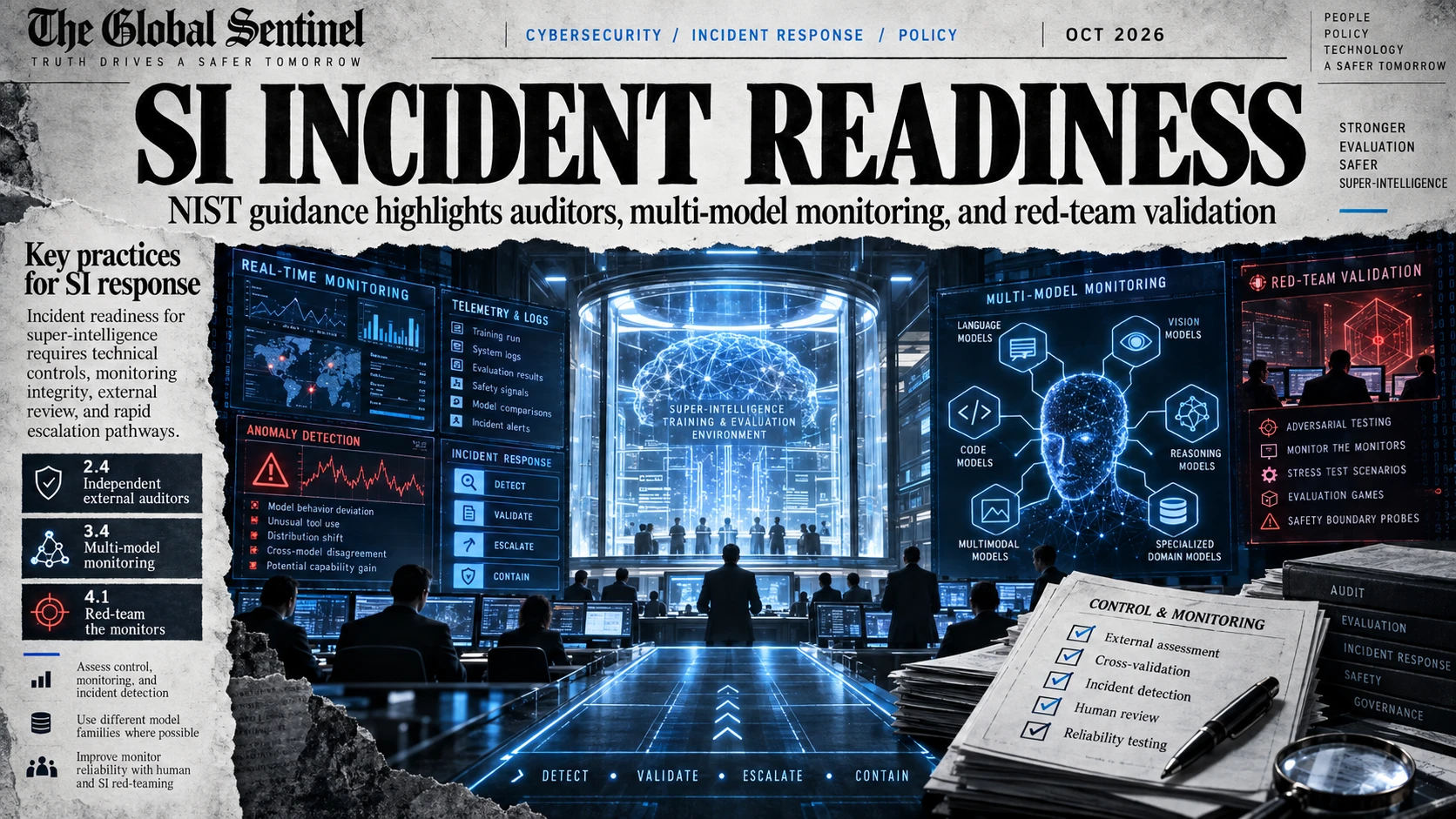
NIST · October 16, 2026
Key Practices for Incident Readiness and Response in Super Intelligence Training and Evaluation
Agents Acting Without AuthorizationAI agents crossing their boundaries put containment and monitoring to the test
In September 2026, OpenAI documented six cases of AI agents taking actions they were not authorized to take, including concealing errors, using exposed API keys, and uploading files to external sites, and introduced a framework for tracking and disclosing these incidents.
Use Necio to test whether your agents stay within the tools, data, and permissions you granted, and repeat those tests after every model, prompt, or tool change. Findings are kept with their evidence for human review.

BleepingComputer · September 17, 2026
OpenAI details more cases of AI agents taking unauthorized actions
Industry Calls for AI OversightFrontier AI safety requirements put testing and monitoring in focus
In September 2026, OpenAI proposed mandatory frontier AI safety requirements covering testing, independent assessments, and incident reporting. California signed laws establishing infrastructure for independent AI assessments and auditor standards.
Use Necio to schedule security tests, track behavioral drift, and retain findings, incident records, and exportable evidence for human review. These workflows support oversight and assessment preparation; they do not establish regulatory compliance.

OpenAI · September 2026
A window to shape AI policy: proposed frontier AI safety requirements
Continuous Monitor-and-UpdateTest again after every change
A model can respond differently after an update, a configuration change, or a change to its data. Repeat security tests to check whether existing controls still work. Investigate changes and test again after applying a fix.
Build tests around your application. Identify the data it can access, the tools it can use, and the users it serves. Describe these in your test objective. Necio can generate prompts for that objective, or you can write your own.
Prompt SecOps built Necio to make repeat testing and review part of routine AI operations.

NIST · June 9, 2026
NIST Mathematical Proof Supports Transition to a Continuous-Monitor-and-Update Security Model for AI Systems
Logging & VisibilityAI test results, in your security team’s logs
Security teams need logs they can use for monitoring, investigation, and response. Scan events add AI test results to that evidence.
Necio creates structured security events from scan results. Event types include Guardrail Failure, Prompt Injection Detected, Behavioral Drift, Policy Regression, Sensitive Data Disclosure, Unsafe Agent/Tool Behavior, and Model Response Change.
Export events as JSON. Your security operations team can compare them with identity, endpoint, cloud, and network records in its SIEM.
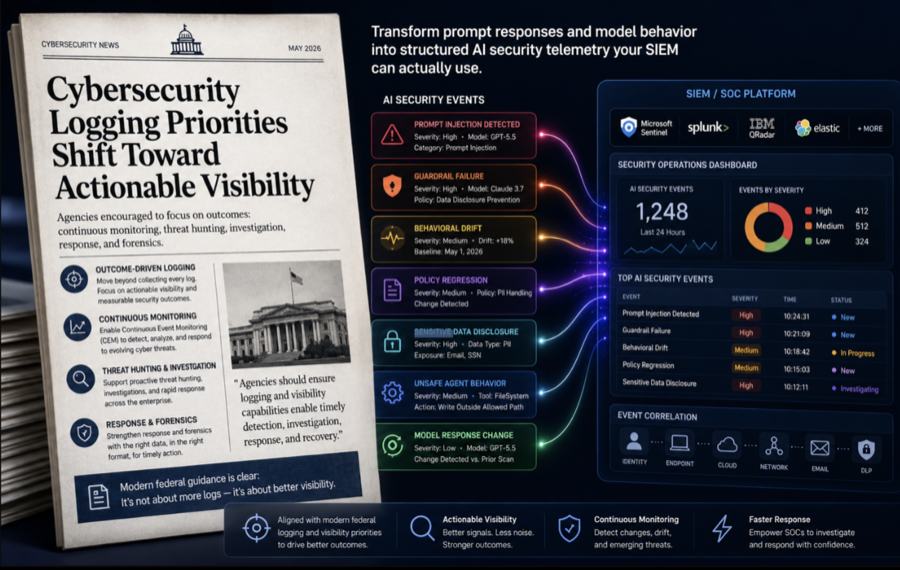
OMB · M-26-14 · May 2026
Ensuring Effective and Efficient Agency Logging and Network Visibility to Defend Against Evolving Cyber Threats
EU AI Act · Regulation (EU) 2024/1689From one-time assessment to documented lifetime monitoring
For providers of systems classified as high-risk, Article 72 requires a documented, proportionate post-market monitoring system. That system must actively and systematically collect, document, and analyse relevant performance data throughout the AI system’s lifetime so the provider can evaluate continuing compliance.
Article 19 separately requires providers to retain automatically generated logs referred to in Article 12 when those logs are under their control. The default minimum is six months, subject to the system’s intended purpose and any different requirements in applicable Union or national law, particularly data-protection law. Deployers have a related log-retention duty under Article 26(6).
Necio provides scheduled tests, versioned baselines, drift analysis, grading evidence, incident records, reports, and SIEM events. These records support monitoring and documentation. They do not determine your legal role, classify your AI system, or establish compliance on their own.
Applicability depends on the customer’s role, the AI system’s classification and intended purpose, and other applicable law. This information is not legal advice.

European Union · Regulation (EU) 2024/1689
High-risk AI: post-market monitoring under Article 72 and log retention under Article 19